Logo timeING
  • Home
  • About
  • Skills
  • Job Stations
  • Recent Posts
  • More
    Featured Posts Projects Selected Publications and Lectures
  • Posts
  • Notes
  • Dark Theme
    Light Theme Dark Theme System Theme
Logo Inverted Logo
  • Tags
  • Academic
  • Accessibility
  • Apps
  • Car-Dependency
  • Committees & Memberships
  • Cycling
  • Data
  • Economics
  • Efficiency
  • FCD
  • Gtfs
  • Healthcare
  • Helper
  • Historic
  • Lectures
  • Media
  • Postgresql V12+
  • Psql
  • Public-Transport
  • Publications
  • Research Dissemination
  • Rural-Mobility
  • Safty
  • Selected-Work
  • Simra
  • Spatial-Analyses
  • Sql
  • Sustainability
  • Urban-Mobility
Hero Image
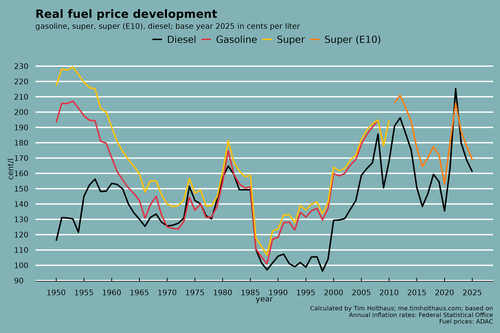
Real fuel prices in Germany as of 2025

The Story Today I came across several plots showing the development of real fuel prices in Germany since 1970, generated with the help of AI. At first glance, some of the price spikes appeared unusually high and did not seem fully consistent with a long-term economic perspective. To verify this, I decided to reconstruct inflation-adjusted fuel prices myself. For this purpose, I used two data sources: the annual inflation rates provided by Destatis and historical fuel price data from ADAC dating back to 1950. By combining these datasets, I recalculated all historical fuel prices to a common reference level—namely the price level at the end of 2025.

  • data
  • car-dependency
Tuesday, April 7, 2026 | 2 minutes Read
Hero Image
Cost Comparison: Public Transport, Ecomobility, and Car Use in Germany

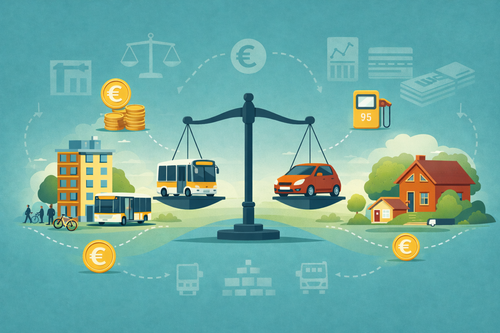
Text is Work-In-Progress Introduction Public debate about mobility often focuses on ticket prices, fuel costs, or whether “owning a car pays off.” This perspective is too narrow. Mobility is not just an individual consumption choice but also a question of infrastructure, spatial structure, social participation, and societal financing. Anyone seriously examining the cost comparison between cars and public transport must consider both direct household expenditures and broader macroeconomic consequences.1 2 In Germany, mobility is spatially very unevenly organized. In densely urban areas, many trips can be completed using the Umweltverbund (ecomobility; the sustainable bundle of public transport, cycling, and walking). In rural areas, however, cars are often not merely a convenience option but a prerequisite for everyday mobility.3 4 This creates a fundamental difference: while cities primarily ask how mobility can be organized affordably and with low emissions, rural areas frequently grapple with ensuring mobility reliability in the first place.4 5
  • gtfs
  • public-transport
  • accessibility
  • data
  • car-dependency
  • urban-mobility
  • rural-mobility
Tuesday, March 31, 2026 | 10 minutes Read
Navigation
  • About
  • Skills
  • Job Stations
  • Recent Posts
  • Featured Posts
  • Projects
  • Selected Publications and Lectures
Contact me:
  • info@timholthaus.com
  • Tim Holthaus