Logo timeING
  • Home
  • About
  • Skills
  • Job Stations
  • Recent Posts
  • More
    Featured Posts Projects Selected Publications and Lectures
  • Posts
  • Notes
  • Dark Theme
    Light Theme Dark Theme System Theme
Logo Inverted Logo
  • Tags
  • Academic
  • Accessibility
  • Apps
  • Car-Dependency
  • Committees & Memberships
  • Cycling
  • Data
  • Economics
  • Efficiency
  • FCD
  • Gtfs
  • Healthcare
  • Helper
  • Historic
  • Lectures
  • Media
  • Postgresql V12+
  • Psql
  • Public-Transport
  • Publications
  • Research Dissemination
  • Rural-Mobility
  • Safty
  • Selected-Work
  • Simra
  • Spatial-Analyses
  • Sql
  • Sustainability
  • Urban-Mobility
Hero Image
Cost Comparison: Public Transport, Ecomobility, and Car Use in Germany

Text is Work-In-Progress Introduction Public debate about mobility often focuses on ticket prices, fuel costs, or whether “owning a car pays off.” This perspective is too narrow. Mobility is not just an individual consumption choice but also a question of infrastructure, spatial structure, social participation, and societal financing. Anyone seriously examining the cost comparison between cars and public transport must consider both direct household expenditures and broader macroeconomic consequences.1 2 In Germany, mobility is spatially very unevenly organized. In densely urban areas, many trips can be completed using the Umweltverbund (ecomobility; the sustainable bundle of public transport, cycling, and walking). In rural areas, however, cars are often not merely a convenience option but a prerequisite for everyday mobility.3 4 This creates a fundamental difference: while cities primarily ask how mobility can be organized affordably and with low emissions, rural areas frequently grapple with ensuring mobility reliability in the first place.4 5


  • gtfs
  • public-transport
  • accessibility
  • data
  • car-dependency
  • urban-mobility
  • rural-mobility
Tuesday, March 31, 2026 | 10 minutes Read
Hero Image
Comparison of Timetable Versions Using Travel Time Isochrones

Isochrones derived from real timetable data enable a direct comparison between different timetable versions. This method plays a key role in identifying deficits within transport networks and irregularities in service frequency. Beyond timetable optimization, visualizing isochrones can also serve as an effective communication tool for public information. By presenting timetable improvements in a simple and easily understandable format, these visualizations foster greater public acceptance of timetable changes. Case Study: Wuppertal Following the reconstruction of the Wuppertal main station and its surrounding area, the new bus terminal—located directly adjacent to the station and accessible from platform one—is expected to be completed within this year. According to timetable data recorded in the EFA system, the terminal is scheduled to open to bus traffic on Sunday, October 28, 2018.

  • gtfs
  • public-transport
  • accessibility
  • data
Wednesday, August 29, 2018 | 2 minutes Read
Hero Image
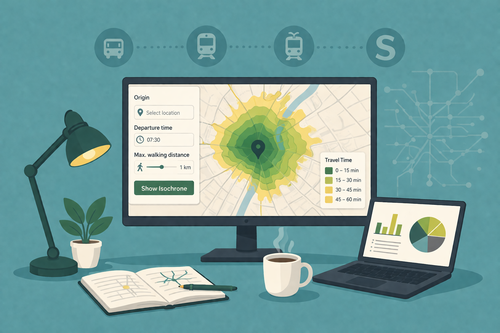
Interactive Accessibility Analysis in Public Transport Using GTFS Data

Data-Driven Accessibility in Public Transport Planning As an initial example of data-driven accessibility analysis in public transport planning, this study presents an evaluation based on timetable data. The analysis relies on data provided in the General Transit Feed Specification (GTFS) format, supplied by the Verkehrsverbund Berlin-Brandenburg under a Creative Commons V3 license. Technical Background Using a spatial grid with a resolution of 100 × 100 meters, travel time isochrones are computed and visualized under defined parameters, such as departure or arrival time, and maximum walking distance. The computation of a single isochrone takes approximately one second, enabling efficient and systematic comparisons between existing (as-is) and planned (target) service scenarios. This analytic approach is particularly effective for identifying accessibility deficits in current timetables and supports evidence-based strategies for developing or updating local public transport plans.

  • gtfs
  • public-transport
  • accessibility
  • data
Sunday, April 22, 2018 | 5 minutes Read
Navigation
  • About
  • Skills
  • Job Stations
  • Recent Posts
  • Featured Posts
  • Projects
  • Selected Publications and Lectures
Contact me:
  • info@timholthaus.com
  • Tim Holthaus